
Leadership in complex organizations is rarely linear, predictable or tidy.
Leaders are constantly interpreting changing circumstances, competing expectations, relationships, emotions, politics and uncertainty. They must make sense of what is happening around them while also making sense of what is happening within themselves.
Leading in the Mess is a framework for understanding how leaders navigate that complexity with purpose.
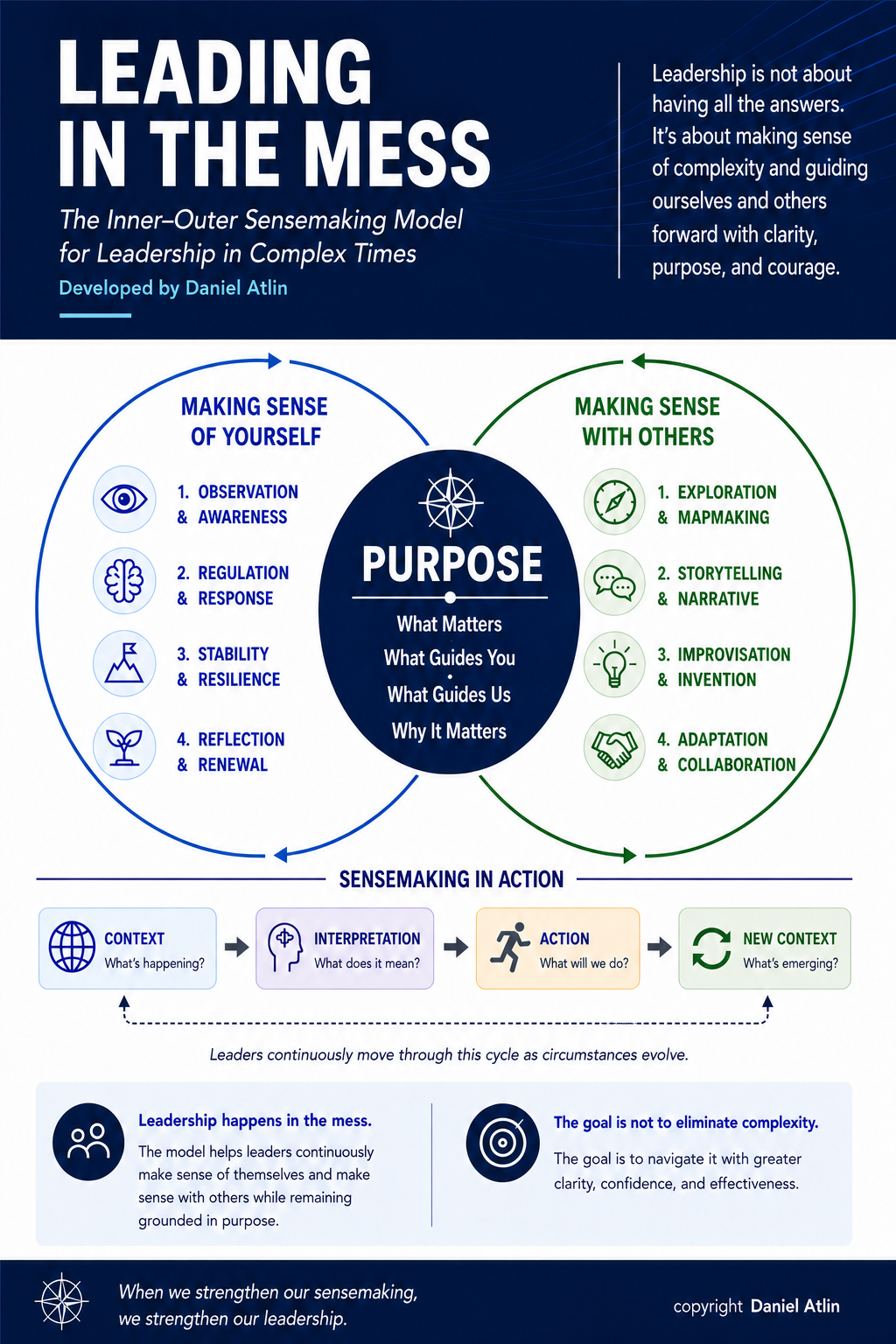
What does it mean to lead in the mess?
Leading in the mess does not mean eliminating complexity or waiting until everything becomes clear. It means developing the capacity to notice what is changing, interpret what matters, understand your own responses, and act purposefully even when the way forward is uncertain.
Two directions of sensemaking
Leading in the mess requires attention in two directions. Leaders need to make sense of the world around them, and they also need to make sense of themselves within it.
Outer sensemaking: making sense with others
Outer sensemaking is about interpreting changing circumstances, stakeholders, narratives, signals, relationships and uncertainty. It involves exploring, mapmaking, storytelling, improvising, adapting and collaborating with others.
Inner sensemaking: making sense of yourself
Inner sensemaking is about noticing your own assumptions, emotions, reactions and patterns. It involves awareness, regulation, resilience and reflection so that you can respond more intentionally rather than simply react.
Purpose at the centre
Purpose sits at the centre of the model because sensemaking is not simply about interpreting complexity. It is about deciding what matters, what should guide our choices, and why the work matters in the first place.
In complex situations, leaders are often pulled in multiple directions by competing demands, stakeholders and pressures. Purpose provides an anchor. It helps leaders test interpretations, make trade-offs and act with greater consistency when there is no obvious answer.
Purpose also connects the inner and outer dimensions of sensemaking. It asks leaders to consider both what guides meand what guides us.
Purpose does not eliminate uncertainty. It helps leaders navigate it with intention.
Sensemaking in action
Sensemaking is not a one-time exercise. Leaders move through a continuous cycle as circumstances evolve.
Context
What is happening? What has changed? What are we noticing?
Interpretation
What might it mean? What patterns, assumptions or competing explanations should we consider?
Action
What will we do? What is the next useful move, even if we do not have complete certainty?
New context
What is emerging as a result? What have we learned, and what now requires our attention?
Leadership in complexity is less about finding the final answer and more about noticing, interpreting, acting and learning.
Where this framework came from
The framework grew out of my research into how leaders navigate change in complex institutions.
As part of my Executive Master’s work at HEC Paris and Oxford Saïd Business School, I interviewed 25 senior university leaders from Canada, the United Kingdom, Australia and New Zealand. Those conversations explored how leaders interpret ambiguity, work through competing demands, build alignment and continue moving when there is no simple answer.
Since then, the framework has continued to evolve through my advisory and coaching work, teaching, governance experience and dozens of conversations with leaders on Messy with Daniel Atlin